


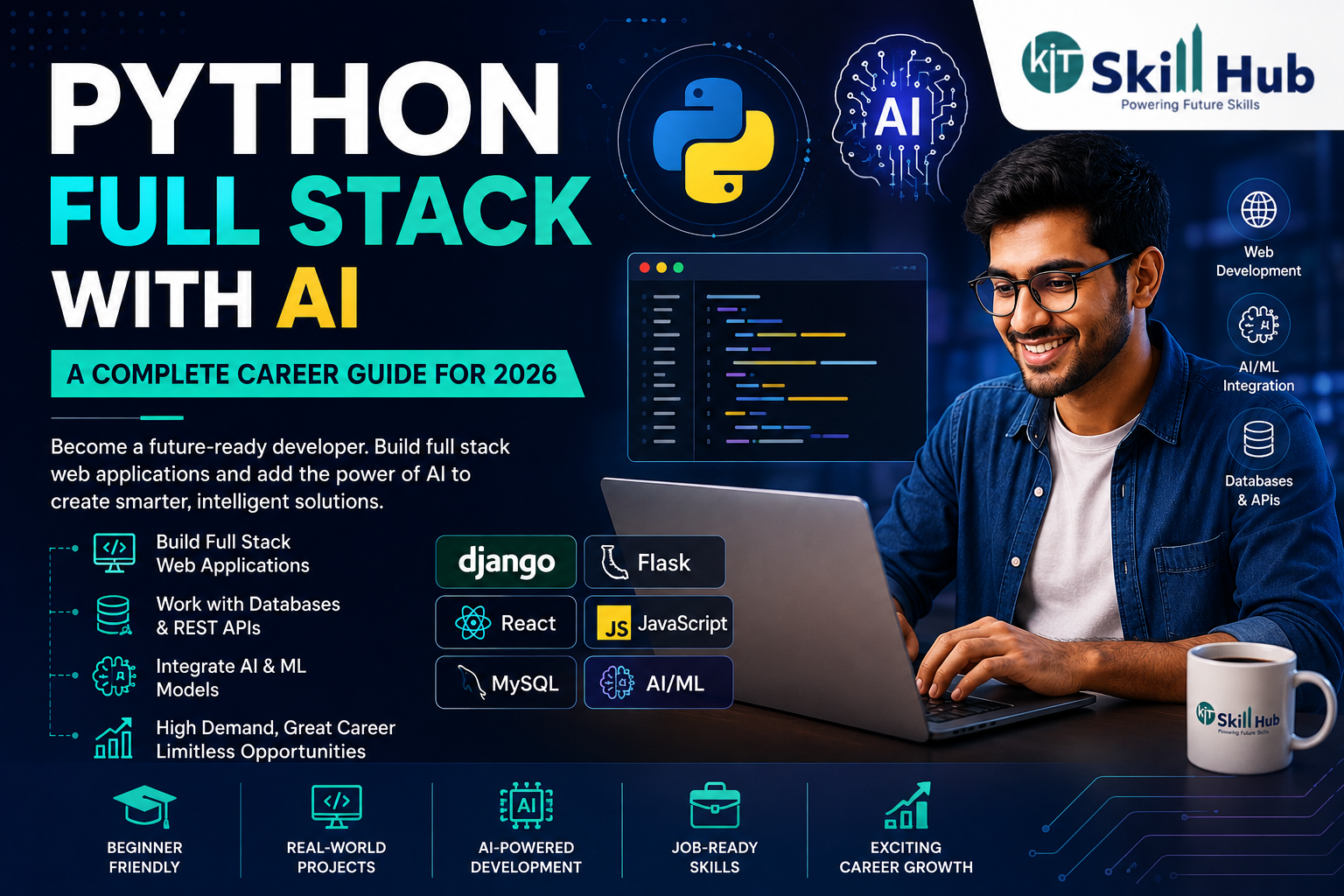
Python Full Stack with AI: A Complete Career Guide for 2026
This is exactly why the role of a python full stack developer has quietly become one of the most valuable job titles in tech right now. And if you’re someone in Hyderabad or anywhere in India, really wondering whether this is the right path for you in 2026, this guide is going to walk you through everything without the usual jargon overload.
Python Full Stack with AI gives developers the ability to work across the entire development process, from creating user-friendly interfaces and building powerful backends to managing databases and integrating AI-powered features. This combination is opening up exciting opportunities for students, freshers, and professionals looking to build future-ready technical skills.
But what exactly does a Python Full Stack developer do? What skills should you learn, what career opportunities are available, and how can you become job-ready? In this guide, we’ll break down the Python Full Stack with AI career path for 2026, including the essential skills, technologies, projects, roadmap, and career opportunities you should know about.
Why Python Full Stack Development Is Growing in 2026
Let’s be honest, Python has been popular for years. But what’s changed is how it’s being used. It’s no longer just the language data scientists reach for. It’s now powering entire web applications end to end from the login page a user sees, to the backend logic that processes their request, to the machine learning model quietly making a recommendation in the background.
A few reasons this shift has picked up speed:
- One language, multiple layers. With frameworks like Django and Flask on the backend, and Python’s growing compatibility with frontend tooling, developers can build more of the stack without constantly switching languages.
- AI is no longer optional. Businesses want features like chatbots, recommendation engines, and automated data analysis built directly into their products, and Python is the natural language for that.
- Startups love speed. Full stack developers who can single-handedly move a product from idea to prototype are incredibly valuable to lean teams.
- Hyderabad’s IT ecosystem is expanding. With more product companies, GCCs, and startups setting up shop in Gachibowli, HITEC City, and Madhapur, the local demand for full stack talent has grown significantly.
Put simply, if you can build and reason about an entire application not just one piece of it you’re solving a bigger problem for employers, and they pay accordingly.
What Does a Python Full Stack Developer Actually Do?
The term gets thrown around a lot, so let’s break it down practically. A full stack developer working with Python typically handles:
On the backend:
- Writing server-side logic using Python frameworks like Django or Flask
- Designing and managing databases (commonly MySQL or PostgreSQL)
- Building and securing REST APIs that connect the frontend to the backend
- Handling authentication, data validation, and server performance
On the frontend:
- Structuring pages with HTML and CSS
- Adding interactivity using JavaScript, or a framework like React
- Making sure the interface actually works well with the backend logic
Increasingly, on the AI side:
- Integrating basic machine learning models into applications
- Using Python libraries for data analysis and visualization
- Working with generative AI tools to automate features like content generation, chatbots, or smart search
You don’t need to be a machine learning researcher to do this. Most full stack roles just expect you to be comfortable enough with AI concepts to plug them into a working product which is a very learnable skill if you start with the right foundation.
Essential Python Full Stack Developer Skills for 2026
There’s a long list of tools people throw at beginners, and it can get overwhelming fast. Here’s a more grounded breakdown of what genuinely matters for a job-ready python full stack developer profile in 2026:
- Core Python: Not just syntax, but a real understanding of data structures, functions, and how to write clean, reusable code.
- Django or Flask: Django for larger, structured applications; Flask if you prefer something lighter and more flexible.
- Frontend basics (HTML, CSS, JavaScript): You don’t need to be a design expert, but you do need to build interfaces that work.
- React: Many companies now expect at least working knowledge of React for building dynamic, component-based interfaces.
- SQL and database design: Especially MySQL, since it’s still the backbone of most business applications.
- Git and version control: Non-negotiable in any real development team.
- Data Structures & Algorithms (DSA): This is what interviewers actually test you on, regardless of how good your projects look.
- Basic AI/ML concepts: Understanding how to use pre-trained models, APIs like Open AI’s, or simple recommendation logic.
- Deployment basics: Knowing how to get your project live, even if it’s a simple cloud deployment.
Notice something? None of this is about knowing everything. It’s about being functional across the stack, with enough depth that you’re not lost when something breaks.
Python Full Stack Developer Career Roadmap
If you’re starting from zero, here’s a practical way to think about the journey, rather than trying to learn everything simultaneously:
Stage 1: Build the Python Foundation Get comfortable with core Python, basic problem solving, and simple scripts. This stage is about confidence, not complexity.
Stage 2: Learn Backend Development Move into Django or Flask. Learn how routing, templates, and databases connect. Build small projects like a to-do app or a simple blog system.
Stage 3: Add Frontend Skills Pick up HTML, CSS, JavaScript, and eventually React. This is where your applications start looking and feeling like real products.
Stage 4: Work on Real Projects This stage matters more than most people realize. Projects like a personal finance tracker, a movie recommendation system using basic machine learning, or a weather forecasting app that pulls live data through APIs these aren’t just portfolio filler. They force you to combine everything you’ve learned into something that actually functions.
Stage 5: Layer in AI Once your fundamentals are solid, start exploring how generative AI and basic ML models can be integrated into your applications. Even a simple chatbot feature or a recommendation engine can make your portfolio stand out significantly.
Stage 6:Prepare for the Job Market This includes DSA practice, mock interviews, resume building, and very importantly being able to explain your projects clearly and confidently.
Why Structured Training Makes a Real Difference
Here’s the honest truth: you can learn all of this on your own through scattered YouTube videos and blog posts. Plenty of people have. But most beginners underestimate how much time gets lost figuring out what to learn next, debugging alone without mentorship, and not knowing whether their projects are actually industry-relevant.
This is where a structured, mentor-led program changes the trajectory. At KIT Skill Hub, based in Gachibowli, Hyderabad, the Full Stack Python Developer training is designed specifically to close that gap. The program takes you through Python, Django for backend development, React for the frontend, and MySQL for database management while also introducing Data Structures & Algorithms and generative AI fundamentals along the way.
What makes it practical rather than purely theoretical is the project work built into the course. Learners work on real applications like a personal finance tracker, a movie recommendation system powered by basic machine learning, and a weather forecasting app that combines API integration with data visualization. These aren’t throwaway exercises they’re the kind of projects that give you something concrete to talk about in interviews.
The training also includes a 2-month internship component, where you get to apply what you’ve learned on live projects under mentor guidance, followed by placement assistance to help you actually convert your skills into a job offer. Whether you’re a complete beginner, a student trying to get ahead of the curve, or a working professional looking to pivot into full stack development, the course is structured to meet you at your current level and take you to job readiness.
Common Questions People Ask Before Starting
Do I need a coding background to start?
No. Most learners start from scratch. The key is consistency, not prior experience.
Is Python full stack development still relevant with AI tools writing code now?
Actually, more relevant than ever. AI tools can help you write code faster, but someone still needs to understand the architecture, debug issues, and make sound technical decisions. That person is the full stack developer.
How long does it realistically take to become job-ready?
With structured, project-based learning, most learners can reach a job-ready level in a few months though the timeline depends on how consistently you practice and build.
Is React necessary, or is JavaScript enough?
JavaScript gets you started, but React is increasingly expected by employers because it’s the standard for building modern, scalable interfaces.
Final Thoughts
The demand for developers who can move fluidly across the backend, frontend, and AI layer of an application isn’t a passing trend it reflects how software is actually being built today. If you’re serious about stepping into this space, the smartest move isn’t trying to learn everything randomly. It’s following a structured path, building real projects, and getting guidance from people who’ve already helped others make this transition successfully.
If you’re in Hyderabad and ready to start this journey with proper mentorship, hands-on projects, and placement support, KIT Skill Hub’s Full Stack Python Developer program is built exactly for that purpose. Visit KIT Skill Hub today to explore the course details and take the first real step toward becoming a job-ready python full stack developer in 2026.
Ready to Start?
If you’re still unsure which format fits your goals, our team can walk you through it based on your background and career target no pressure, just a clear picture of what would actually work for you.
📌 Book a free demo class at KIT Skill Hub, Gachibowli or Ameerpet, and experience the hybrid model firsthand.
[Explore our courses→] | [See our placed candidates →] | [Book a Free Consultation →]