


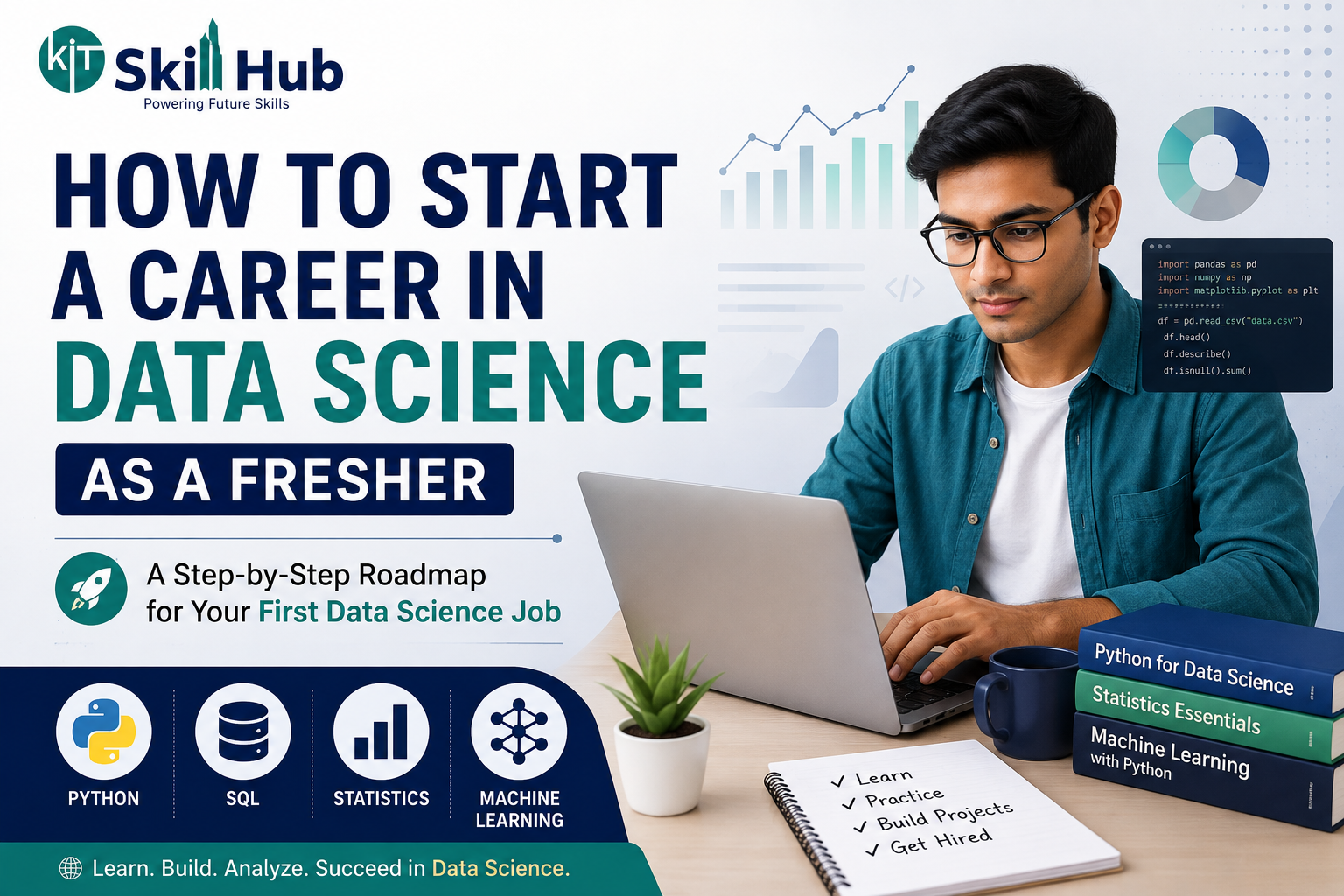
How to Start a Career in Data Science as a Fresher in 2026
If you’re searching for a data science course as a fresher, you’ve probably noticed the growing demand for data professionals. Every industry, from healthcare to banking to e-commerce, is now using data to make better decisions and needs skilled professionals who can turn that data into useful insights. A structured data science course can help you learn these fundamentals in the right order and avoid the confusion that comes with random self-learning.
But here’s the catch. Most freshers look at data science job listings and immediately feel out of their depth. Machine learning, Python, statistics, SQL, deep learning – the list of “required skills” can feel like a wall built specifically to keep beginners out.
It isn’t. That wall only looks solid from a distance. Up close, it’s just a series of steps, and every single one of them is learnable, even if you’ve never written a line of code in your life.
This guide breaks down exactly how a fresher – yes, even someone from a non-technical background – can go from “I don’t even know what a data scientist does” to holding an offer letter.
What Does a Data Scientist Actually Do?
Before chasing the title, it helps to understand the job. In simple terms, a data scientist takes raw, messy data and turns it into decisions. That could mean predicting which customers are likely to cancel a subscription, building a model that flags fraudulent transactions, or helping a hospital forecast patient admissions.
The role sits at the intersection of three skills:
- Statistics – understanding patterns, probability, and what the numbers are really telling you
- Programming – writing code (usually Python) to clean, analyze, and model data at scale
- Business Sense – knowing which questions are worth asking in the first place
None of these require you to be a math prodigy or a coding genius from birth. They require consistent practice and the right structure to learn in.
Should You Self-Learn or Join a Data Science Course?
It’s fair to be skeptical of any career path that gets called “the future” every other year. So let’s look at why data science holds up under scrutiny, especially for someone just starting out.
The demand isn’t slowing down. Nearly every industry – retail, banking, healthcare, logistics, tech – now runs on data, and the World Economic Forum’s Future of Jobs Report 2025 projects over 11.5 million new data-related jobs globally by 2026. That’s not a niche market; that’s mainstream demand.
Companies are actively hiring freshers. A common myth is that data science is only for experienced engineers. In reality, hiring managers are increasingly open to fresh talent – roughly 67% say they’re willing to hire freshers into data science roles, provided the candidate can show real project work and applied skills, not just a degree.
The pay reflects the demand. Entry-level data science professionals in India typically start in the ₹2.4 LPA to ₹8 LPA range depending on skill level and location, with strong professionals reaching ₹8 LPA average packages and top performers crossing ₹23 LPA even relatively early in their careers.
It’s future-proof, not future-threatened. Unlike roles that AI might eventually automate, data science is the field building and directing that AI. As generative AI, machine learning, and automation reshape every industry, the people who understand data will be the ones steering that change, not being replaced by it.
Step 1: Get Comfortable With the Fundamentals
You don’t need to master everything on day one. Start with the building blocks:
Python is the language of choice for data science, and for good reason – it’s readable, has a massive ecosystem of libraries, and is used everywhere from small startups to research labs. Begin with Python basics, then move into Pandas and NumPy, the two libraries that let you clean, reshape, and analyze data efficiently.
SQL is non-negotiable. Almost every company stores its data in relational databases, and knowing how to pull exactly the information you need with a query is a skill you’ll use in literally every data role, not just data science.
Statistics doesn’t mean advanced calculus. It means understanding averages, distributions, correlation versus causation, and probability well enough to know when a result is meaningful and when it’s noise.
Trying to learn all of this alone, through scattered YouTube videos and half-finished online courses, is exactly where most self-taught beginners get stuck. A structured data science course removes that guesswork by sequencing these fundamentals in the right order, with someone checking your understanding along the way.
Step 1: Build the Fundamentals for a Data Science Course
Once you can write basic Python and SQL, the next skill is exploratory data analysis (EDA) – essentially, getting a “feel” for a dataset before you build anything on top of it. This includes identifying missing values, spotting outliers, and using visualization tools to see patterns that raw numbers hide.
This is also where tools like Power BI and Seaborn come in, letting you turn spreadsheets full of numbers into charts a non-technical manager can understand in five seconds. Being able to explain data visually is often what separates a data scientist who gets listened to in meetings from one who doesn’t.
Step 3: Move Into Machine Learning
This is the part most freshers are most excited about, and understandably so. Machine learning is where you teach a model to recognize patterns and make predictions – whether that’s forecasting sales, classifying emails as spam, or recommending products.
Start with core concepts and popular libraries like Scikit-Learn, then progress into deep learning frameworks such as PyTorch as your confidence grows. You don’t need to master every algorithm that exists. You need to deeply understand a handful of them, know when to use each, and be able to explain your reasoning – because in interviews, “why did you choose this model” comes up far more often than “list every algorithm you know.”
Step 4: Get Familiar With the Modern AI Stack
Data science in 2026 doesn’t stop at traditional machine learning. Generative AI, large language models, and prompt engineering are becoming part of the standard toolkit, and MLOps – the practice of deploying and monitoring models in real-world production environments using tools like MLflow, Docker, and cloud platforms like AWS – is what separates a model that works in a notebook from one that actually runs in a business.
Freshers who pick up even a working understanding of this modern stack alongside the fundamentals stand out immediately, because it signals you’re learning for where the field is heading, not just where it’s been.
Step 5: Build a Portfolio That Proves You Can Do the Job
Certificates tell an employer what you studied. Projects tell them what you can actually do. This is the single biggest gap between freshers who get hired and freshers who don’t.
Aim to build a small portfolio that includes:
- A data cleaning and exploratory analysis project on a real (not toy) dataset
- A machine learning model solving an actual business problem, like churn prediction or price forecasting
- A visualization dashboard built in Power BI or a similar tool
- Ideally, one end-to-end project that goes from raw data to a deployed, working model
Working on live projects and completing a hands-on internship, rather than only classroom theory, is what makes this portfolio credible. It’s the difference between saying “I learned machine learning” and being able to walk an interviewer through a project you actually built and debugged yourself.
Step 6: Prepare for the Job Search, Not Just the Skills
Technical skills get you shortlisted. Communication gets you hired. A lot of freshers underestimate how much of a data science interview is about explaining your thinking clearly – walking through your approach to a problem, defending your choices, and translating technical results into plain language for a non-technical audience.
This is why structured, mentor-led interview preparation and mock interviews matter as much as the technical curriculum itself. It’s one thing to know the answer; it’s another to communicate it confidently under pressure.
Which Roles Can You Actually Target as a Fresher?
Data science isn’t a single job title – it’s a family of closely related roles, and understanding the differences helps you position yourself better:
- Data Analyst – focuses on interpreting existing data and building reports/dashboards
- Data Scientist – builds predictive models and works on more advanced statistical problems
- Machine Learning Engineer – focuses on building and deploying ML models into production
- Business Analyst – bridges data insights with business strategy and decision-making
- Data Engineer – builds and maintains the data pipelines and infrastructure everything else runs on
- AI Specialist – works on generative AI, LLMs, and applied AI solutions
- Research Analyst / Data Consultant – applies data analysis to specific industries or client problems
As a fresher, you don’t need to pick one forever. Many people start as a Data Analyst or Junior Data Scientist and specialize over the next two to three years as they discover what they enjoy.
Should You Self-Learn or Join a Structured Program?
Self-learning is possible, and some people do succeed with it. But it comes with real costs that often go unmentioned – months lost to trial and error, no one to catch bad habits early, no accountability to actually finish what you start, and no real feedback on whether your projects are portfolio-worthy or just practice.
A structured, project-based data science course solves all four problems at once, especially one with mentorship, live projects, and dedicated placement support. It compresses what could be a scattered, 18-month self-taught journey into a focused, guided program with a clear beginning and end point: a job.
Why Freshers in Hyderabad Choose KIT Skill Hub for a Data Science Course
If you’re based in Hyderabad and searching for a data science course that’s actually built around getting freshers hired – not just handing out a certificate – KIT Skill Hub’s Data Science Career Program is designed exactly for that gap.
Here’s what sets the program apart:
Two learning tracks based on where you’re starting from. The Data Science & AI Certification Program is built for beginners and aspiring analysts, covering Python for data analysis, SQL, and exploratory data analysis and visualization. The Professional Diploma in Applied AI & ML is designed for engineers and tech professionals ready to go deeper into machine learning, deep learning, generative AI, LLMs, prompt engineering, and MLOps.
A genuinely industry-standard toolchain. You’ll work hands-on with Python, Scikit-Learn, PyTorch, MLflow, Jupyter, GitHub, Docker, AWS, Power BI, Seaborn, and more – not a simplified, watered-down version of the tools used in real companies.
Real structure, not vague promises. The certification program includes 14 core modules, over 160 learning hours, 4 months of structured training followed by a 2-month internship, and 100% placement assistance.
Learning that goes beyond theory. The program is built around practical, project-based learning, real application development instead of demo projects, structured mentorship, and portfolio-ready outcomes, paired with dedicated career and interview preparation support.
Certification that means something. On completing the course, you receive the KIT Skill Hub Data Science Certificate covering data analysis, Python, statistics, machine learning, and real-world projects, along with preparation aligned to globally recognized Data Science and Analytics certifications.
A program open to more than just CS graduates. Whether you’re a student entering the field, a professional transitioning into tech, a complete non-coder starting from scratch, or an entrepreneur wanting to use data in your own business, the program is structured to meet you at your starting point.
With learning hubs in Gachibowli and Ameerpet, hybrid learning options, and a track record of helping students move from classroom training into internships and job offers, KIT Skill Hub has built its Data Science program specifically around one outcome – getting freshers from “interested in data” to “hired as a data professional.”
Your Next Step
Breaking into data science as a fresher isn’t about already knowing everything. It’s about picking a clear path, building real projects along the way, and having the right support system when you get stuck – because you will get stuck, and that’s exactly where most self-learners give up. The right data science course can give you the structured learning, projects and practical experience needed to move from beginner to job-ready professional.
If you’re ready to stop researching and actually start, explore the Data Science Career Program at KIT Skill Hub, check the curriculum, and talk to their team about which track – Certification or Professional Diploma – fits where you’re starting from.
FAQs
1. Can I become a data scientist with no coding background?
Yes. Most successful data scientists started with zero coding experience. A structured course builds your Python and SQL skills from the ground up, so a non-technical background isn’t a barrier – it just means you start at the beginner track.
2. How long does it take to become job-ready in data science?
With a structured program combining classroom training and an internship, most freshers become job-ready in 4 to 6 months, compared to 12-18 months or more of unfocused self-study.
3. Do I need a degree in computer science or statistics to enter data science?
No. While a technical or analytical background helps, many successful data scientists come from commerce, biology, economics, and other non-CS fields. What matters more is your project portfolio and applied skills.
4. What is the average salary for a fresher data scientist in India?
Fresher salaries typically range from around ₹2.4 LPA to ₹8 LPA depending on skills, projects, and location, with strong performers earning significantly more as they gain experience.
5. What’s the difference between a Data Analyst and a Data Scientist?
A Data Analyst primarily interprets existing data and builds reports and dashboards, while a Data Scientist goes further – building predictive models and applying advanced statistical and machine learning techniques to solve more complex problems.
Ready to Start?
If you’re still unsure which format fits your goals, our team can walk you through it based on your background and career target no pressure, just a clear picture of what would actually work for you.
📌 Book a free demo class at KIT Skill Hub, Gachibowli or Ameerpet, and experience the hybrid model firsthand.
[Explore our courses →] | [See our placed candidates →] | [Book a Free Consultation →]